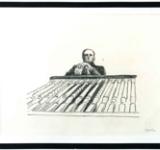
at the Biennale Central Exhibition "Eveywhere but Now"
The Mediterranean experience: The Mediterranean as a spatial paradigm for the circulation of ideas and meaning. An introduction.
The subject of “the Mediterranean” has been extensively researched by the greatest historians of the twentieth century. In our exhibition at the MMCA we did not intend to follow a Braudelian approach or ponder on the composition of the cultural environment of a region that lies at the crossroads of Europe, Asia, and Africa and was the birthplace of recorded history. Our approach is intuitive, rather than analytical. What we call the Mediterranean experience has to do with people and things that are not directly related to the Mediterranean as a geographical and historical concept. The history of forms which focuses on quotidian practices and social representations, impressions, experiences and mentalities, now represents an important chapter of historical research, which deals with everyday life. Only rarely, however, are artistic practices and individual artworks studied in connection to the mentalities of everyday life. Even more rarely does art history recognize that artists, from Gustave Courbet onwards, proceed from or participate in everyday life and that their work is inspired by and addressed to their surrounding reality.
In this exhibition, the Mediterranean experience relates to a series of relations and correlations
which, before serving as the foundation of concrete practices, constitute events which amount to overturns or series, durations or developments, transitions or distributions, limits or terms that allow one to reflect on and identify a variety of forms. The Mediterranean experience is a collection of impressions and experiences from everyday life that give the audience the opportunity to realize that for many gestures and practices one does not have to resort to the basic categories of metaphysics.
The exhibition “The Mediterranean experience: The Mediterranean as a spatial paradigm for the circulation of ideas and meaning. An introduction” features more than 140 contemporary works of art. The roster of participating artists includes Mario Merz, , Pier Paolo Calzolari, Alighiero Boetti, Michelangelo Pistoletto, Giulio Paolini, Thodoros, Takis, Stathis Logothetis, Vlassis Caniaris, Nikos Kessanlis, Daniel, and Constantin Xenakis, as well as “non-Mediterranean” artists, whose work and style have been transformed by what we call the Mediterranean experience, including Richard Long, Edward Kienholz, Jean Tinguely, , Richard Hamilton, Daniel Buren, Joseph Kosuth, Lawrence Weiner, Silvie and Chérif Defraoui, and Marina Abramović. The experience is complemented by a number of younger artists, who preferred the experiences in everyday life over the eclecticism of postmodern art (Mike Kelly, Franz West, Martin Kippenberger, Tadashi Kawamata, Matt Mullican, Juan Muñoz, Remo Salvadori, and others). The exhibition also includes works by representative Greek artists, including Rena Papaspyrou, Leda Papaconstantinou, Dimitris Alithinos, Diochante, Giorgos Lazogas, Thanassis Totsikas, George Hadjimichalis, Nikos Navridis, Yiorgos Harvalias, Maria Papadimitriou, Panos Charalambous, Nikos Charalambidis, and Miltos Manetas.
We will conclude this brief presentation of the exhibition with the example of Richard Long: In 1968, Long went from the banks of River Avon in Bristol to Amalfi, Italy, to take part in the Αrte Povera-Azioni Povere international event. His action, his azione povera, was to put on a sweatshirt of his school, Saint Martin’s College, go to the city and offer to shake hands with everyone he met along the way. He was thus transforming this conventional, gentlemen’s agreement gesture into a Mediterranean act of unconditional acknowledgment of the Other. “The other is the other” is a tautological idea of otherness; difference is not treated in the folkloric sense, but becomes a notion that transforms all kinds of fixed use and habit. The handshake, therefore, affirms the act of beginning a relationship with the unfamiliar (the Other) instead of validating that which is already known or sealing the deal one has just clinched (the Self).From now on, we can hermeneutically pursue this attempt to identify a Mediterranean experience, starting from the premise of a working hypothesis. The exhibition offers a deeper insight into the composition of a natural and conceptual paradigm of spatial relationships and connections, by presenting works of art which allow us to identify, classify, transmit and reproduce the set of distinct practices and methods artists use in their reflections on the relationships they have with their work and the world in general.
Denys Zacharopoulos
Venue:
MACEDONIAN MUSEUM OF CONTEMPORARY ART
Info:
Curator: Denys Zacharopoulos
Assistant curators: Alexios Papazacharias, Maro Psyrra
18.09.2013 – 31.12.2013
Egnatia 154 (on the grounds of the Thessaloniki International Fair)
Sun 11:00-15:00, Tue-Thu-Sat 10:00-18:00, Wed 10:00-22:00, Fri 10:00-19:00
Τ: +30 2310 240002, 2310 240403, 2310 251928
Artworks: