at the Biennale Central Exhibition "Eveywhere but Now"
Vasso Katraki: In Black and White
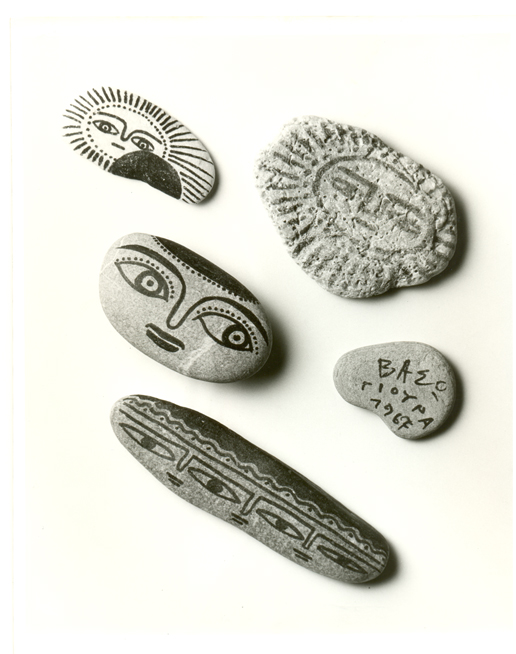
The Teloglion Foundation of Art in the framework of the 4th Biennale of Thessaloniki organizes the exhibition Vasso Katraki: In Black and White. Vasso Katraki is the greatest Greek engraver; her work illustrated the agony and the passage of the Greek people into the difficult post-war period. Through her socially and politically charged work the artist broadcast the universal message of humanism and also essentially reformed the art of engraving, on which she worked almost exclusively. She won many international awards, including the one she earned in another important Biennale, the Biennale of Venice, in 1966, certainly a pivotal point for Greek engraving. The Greek Commissar was Tony Spiteris. The presentation of key moments of her artistic career through engravings, matrices, the famous pebbles from Gyaros, but also lesser-known paintings, watercolors, and costumes for theatrical plays, as well as material from the Tony Spiteris Archive, provide visitors to this exhibition the opportunity to trace the emblematic artistic course of an engraver who managed to connect the individual with the collective in a unique way.Aiming to provide a comprehensive presentation of the engraver’s work, the exhibition comprises 150 works of art. Katraki’s politically charged works impose in the display. Katraki was a member of the Left but was never subordinated to the artistic guidance given by the party. She focused on the emergence of labor issues and folk art. The unique use of the stone as engraving material, instead of the rather popular woodcut or etching, led her to utilize materials and tools that the folk artisans used. One of her favorite themes is her native place, the Aitoliko lagoon, which the artist depicts not only as an idyllic landscape, but also as a workplace, thus joining the modern environmental concerns about water use in the Mediterranean, a major issue for both contemporary artists and the local communities.
Vasso Katraki’s unmistakable works captured the events and images of the Greek history during the 20th century. However, apart from her figural choices, characteristic are the harsh confrontations between black and white, which bring to mind her beloved verse by Elytis: “I searched for white as the ultimate intensity of black”. The vertical compositions and elongated figures resemble on one hand the Cycladic figurines and on the other Modigliani’s shapes, while at the same time retaining a unique style. All the above form an integral part of the broader searches of Greek artists in the second half of the 20th century.
The exhibition is accompanied by valuable photographic and archival material on public display for the first time. It serves particularly to document Katraki’s nomination at the 1966 Biennale of Venice, her activity in Thessaloniki, and other aspects of her personality in an era of historical turbulence for Greece. As is generally the case with Teloglion’s exhibitions, this one will also be accompanied by educational programs at all educational levels, guided tours, and many parallel events.
Panagiotis Bikas
Venue:
TELOGLION FOUNDATION OF ART – AUTH
Info:
General coordination: Prof. Alexandra
Goulaki-Voutyra
Curators: Dr. Panagiotis Bikas, art historian, Christina Tsangalia, archaeologist
Artistic curator: Panidou Marietta, Master of Fine Arts (MFA), Graphic Design, College of Creative Arts, School of Art and Design, West Virginia University, U.S.A.
Collaborating Organisations: Vasso Katraki Museum – Center of Engraving Arts
18.09.2013 – 10.01.2013
159A Ag. Dimitriou Str., 54636 Thessaloniki
Mon-Tue-Thu-Fri 09:00-14:00 /
Wed 09:00-14:00 &17:00-21:00 /
Sat-Sun 10:00-18:00
Τ: +30 2310 24711, 2310 991610
Artworks: